Nuclear Power Plant Accident: What to Do When Radiation Is Released
▶ PLAY FREE NOWNo download · Phone or PC · 3–5 minutes per run · 10 languagesA nuclear power plant accident is not a nuclear explosion. There is no blast and no flash; the danger is an invisible radioactive plume carried by the wind. So the core advice is the opposite too: rather than fleeing in a hurry, get inside the nearest concrete building, close it up and listen to official broadcasts until you are told what to do next. This guide follows the order in which things actually happen, based on the resident protection guidance of Korea's Nuclear Safety and Security Commission (NSSC), the Ministry of the Interior and Safety's national disaster safety portal, and the City of Ulsan's radiological emergency manual.
- White and blue alerts: carry on as usual, listen to broadcasts and get ready to leave.
- Shelter-in-place order: get inside the nearest concrete building. Close doors and windows, turn off air conditioning and fans, cover food.
- If you were outside: bag your outer clothes and wash (no conditioner).
- Potassium iodide: only when told to, one age-appropriate dose.
- Evacuation order: switch off, lock up and go to the designated assembly point or route in an orderly way.
1. What the three alert levels mean (white, blue, red)
Korea announces nuclear plant emergencies in three levels according to how far the effects reach (Act on Physical Protection and Radiological Emergency, Article 17; NSSC).
- White alert: radioactive material is confined to the reactor building. Residents carry on as usual and listen to broadcasts.
- Blue alert: effects reach the plant site. Listen to broadcasts and prepare to evacuate (medicine, jacket, water, portable radio, ID).
- Red alert: effects may spread beyond the site. If the government or local authority orders sheltering or evacuation, follow it.
Protective actions are planned around emergency planning zones: roughly 3–5 km from the plant is the precautionary action zone and roughly 20–30 km is the urgent protective action planning zone (same Act, Article 20-2). Japan's Nuclear Regulation Authority uses a similar split in its nuclear emergency response guidelines: about 5 km (PAZ) and about 30 km (UPZ). Check in advance whether your home or workplace is inside a zone on your local government's website.
2. If a big earthquake hits near a nuclear plant
A nuclear accident can come together with other disasters such as an earthquake or tsunami. Deal with them in order.
- While the ground shakes: get under a sturdy table, hold on to its leg and protect yourself. Don't run outside while it is shaking (Korea's earthquake guidelines).
- If a tsunami warning is issued: move away from the coast and to high ground. If the sea suddenly pulls back, a tsunami is coming (Ministry of the Interior and Safety, Korea Meteorological Administration). Driving along the coast road to "get out first" is dangerous.
- Get plant news from official channels: radio, TV and emergency text alerts tell you the alert level and what to do.
3. When you are told to shelter in place
While a radioactive plume passes, a concrete building cuts the radiation reaching you from outside, and closing doors and windows reduces how much radioactive material you breathe in. The shelter-in-place rules in the national disaster safety portal's nuclear accident guidance are:
- Go inside your home or the nearest concrete building. A windowless inner room in the middle of the building is better. If home is far, go into a nearby public building.
- Close doors and windows and turn off air conditioning and ventilation fans so outside air stays out.
- Cover food and water, including outdoor storage jars (Ulsan guidance).
- Keep checking radio, TV and emergency text alerts for instructions.
- A car is not a shelter. Cars give almost no protection from radiation. If you were driving, go into the nearest concrete building.
- Never run a car engine for heat in a closed garage. Carbon monoxide builds up quickly (National Fire Agency).
Sheltering is not meant to last forever. Ulsan's manual explains that sheltering is ordered when the projected dose over two days exceeds 10 mSv and should not last more than two days, and that evacuation is decided when the projected dose over a week exceeds 50 mSv. These numbers are decision thresholds for protective actions, not levels at which health damage occurs.
4. If you were outside: wash and change
If you were outdoors when the plume passed, remove radioactive material from your body as soon as you get inside.
- Take off your outer clothes, seal them in a plastic bag and keep it away from people. The US CDC says removing your outer layer of clothing can remove about 90% of radioactive material on you.
- Wash with soap and shampoo, but no conditioner. Conditioner binds radioactive material to your hair (US CDC). If you can't shower, wipe exposed skin with a damp cloth.
- Don't scrub or scratch your skin.
5. Potassium iodide: when to take it and how much
Radioactive iodine that can be released in a nuclear plant accident collects in the thyroid. Potassium iodide (KI) tablets fill the thyroid with stable iodine first so radioactive iodine can't build up.
- Take it only when officials tell you to. Too early and it wears off before the plume arrives; too late and it works less well. That is why authorities announce the timing.
- One age-appropriate dose. Adults and children 12 and older take one 130 mg tablet; younger children and infants take the smaller amount they are told to. Taking more does not protect you more; it only adds side effects. One dose protects for about 24 hours; take another only if told to (NSSC, US FDA).
- It only blocks radioactive iodine. It does nothing against other radioactive materials or radiation from outside your body, so taking a tablet is no reason to go outdoors.
- If you are allergic to iodine or have certain thyroid conditions, tell a doctor or the distribution staff before taking it.
- Don't panic-buy at pharmacies. In Korea, local governments stockpile the tablets and hand them out when needed. Ulsan, for example, keeps them at community service centers and distributes two tablets per person through local offices when the order to take them is given.
- Seaweed, kelp, salt and iodine antiseptic are not substitutes. They don't work and can be harmful (NSSC, WHO).
6. When an evacuation order comes
If radiation levels are expected to rise further, authorities order an evacuation for specific zones (national disaster safety portal).
- Take only essential medicine and supplies. Heavy luggage slows down boarding the buses. Don't forget ID.
- Switch off electricity and gas, lock the door and hang a white towel on it to show the home has been evacuated.
- Go to the designated assembly point or route, calmly. If you drive, follow the official route and don't use the hard shoulder, drive against traffic or take shortcuts. A crash in the jam can be more dangerous than the radiation.
- If you are at work or out, don't go back home into the restricted zone. Go to relatives outside the affected area or to an assigned relief shelter (Ulsan guidance).
- Don't go to pick up family at schools or hospitals. Those institutions evacuate people themselves; check on them by text or at the relief shelter.
- For pets, follow local instructions. If you can't take them, leave them in a cage with plenty of food and water.
Hasty evacuation has risks of its own. After the 2011 Fukushima accident, some elderly hospital and care-home patients who were moved in a rush without preparation died during the evacuation. That is why moving in order, on official instructions, matters.
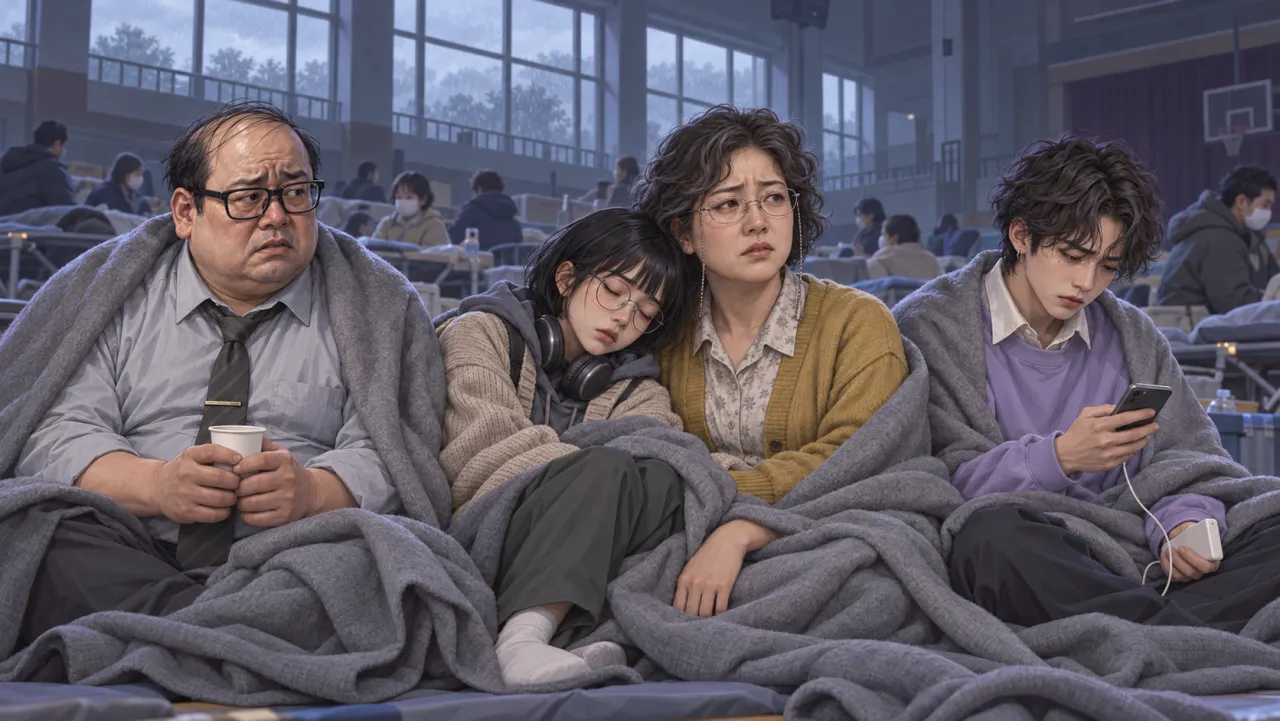
7. At the relief shelter
Relief shelters usually work in this order: registration → body contamination screening → decontamination shower (if contaminated) → medical care and contacting family (national disaster safety portal and local guidance). Don't skip screening to look for family first; walking around contaminated can spread it to others.
8. Rumors, phone calls and family
Trust official broadcasts only. In a disaster, rumors like "there's been another explosion" or "the pharmacies are out of iodine" spread faster than facts. Check the radio, TV (KBS is Korea's designated disaster broadcaster), emergency text alerts and the government's Emergency Ready app (안전디딤돌).
Text instead of calling. Voice networks jam in a disaster, while short texts get through more easily. Save your phone battery for instructions and contacting family.
Stock up three days of supplies
For several days during and after sheltering or evacuation, shops may close and power, water and phone service may be unreliable. In October 2026 the Japanese government (with the launch of its new disaster management agency) and the UK government (Be Ready campaign) again advised every household to keep at least three days, ideally a week of water and food. Korea's national disaster safety portal checklist points the same way.
- Water: about 3 L per person per day for at least 3 days, ideally in sealed bottles.
- Food: canned food, instant rice and energy bars that need no cooking.
- Portable radio, spare batteries, flashlight and power bank so you can hear official broadcasts during a blackout.
- Regular and prescription medicine, masks, plastic bags and wet wipes, a copy of your ID and some cash.
- A go-bag kept in one place so you can leave immediately if evacuation is ordered.
No need to panic-buy. Add a little each time you shop, then eat and replace (rotating stock) so your supplies stay fresh.
Practice with a simulation
"Stay inside" is easy to read, but hard to stick to when your boss is jingling the rental-car keys and shouting "just drive 30 km and we're fine." Ulsan Nuclear Accident: 3 Hours to the Radioactive Plume is a free browser game where you make these decisions against the clock, in a branch-office meeting room during a fictional plant accident. See the game guide.
Sources
- Nuclear Safety and Security Commission (Korea): resident protection guidance for radiological emergencies; thyroid blocking (potassium iodide) guidance via Gov.kr
- Ministry of the Interior and Safety (Korea), national disaster safety portal: nuclear accident, earthquake and tsunami guidance; Emergency Ready app (안전디딤돌)
- Act on Physical Protection and Radiological Emergency, Articles 17 and 20-2 (Korea Law Information Center)
- City of Ulsan: radiological emergency manual, radiological emergency plan, citizen action alerts
- Korea Meteorological Administration: tsunami information
- National Fire Agency (Korea): carbon monoxide safety
- US CDC radiation emergency guidance (decontamination, conditioner); US FDA potassium iodide FAQ; WHO guidance on iodine thyroid blocking
- Nuclear Regulation Authority (Japan): Nuclear Emergency Response Guidelines (PAZ, UPZ)
This article is general educational information, not official emergency guidance. In a real emergency, follow instructions from your government and local authorities.
FAQ
Should I flee immediately if there is a nuclear plant accident?
No. Driving off without instructions often leaves you stuck in traffic in a car as the plume passes. If you are told to shelter in place, stay in the nearest concrete building with doors and windows closed; if evacuation is ordered, follow the designated route.
What is the difference between the white, blue and red alerts?
White means effects are confined to the reactor building (carry on as usual), blue means they reach the plant site (prepare to evacuate), and red means they may spread beyond the site (shelter or evacuate as instructed).
When should I take potassium iodide?
Only when the government or local authority tells you to, as one age-appropriate dose. People 12 and older take one 130 mg tablet. Taking it early or taking more does not make you safer.
Should I buy iodine tablets at a pharmacy?
In Korea, local governments stockpile potassium iodide and hand it out when the order is given. Iodine supplements, seaweed, kelp, salt and antiseptics are not substitutes and can be harmful.
Where is the best place to shelter in place?
A windowless inner room of a concrete building. Close doors and windows and turn off air conditioning and fans. A car gives almost no protection from radiation and is not a shelter.
What should I do if I may have been exposed to radioactive material?
Go inside, put your outer clothes in a plastic bag, and wash with soap and shampoo but no conditioner. Removing your outer clothes alone can remove about 90% of the radioactive material on you (US CDC). Get screened at the relief shelter.
Should I pick up my child from school?
No. Schools and hospitals evacuate people themselves. Going to get them can expose you or trap you in traffic; check on them by text or at the relief shelter.
What should I take if an evacuation is ordered?
Only essential medicine, supplies and ID. Switch off power and gas, lock the door, hang a white towel and go to the designated assembly point or route to the relief shelter.